The Uncanny Valley of AI Personalization (And How to Avoid It)

In 1970, robotics professor Masahiro Mori proposed something counterintuitive in an essay for the Japanese journal Energy that went largely unnoticed for decades. He argued that as robots become more humanlike, our affinity for them increases, but only to a point. Once the resemblance gets close-but-not-quite-right, comfort plummets into revulsion. He called this dip “bukimi no tani”: the uncanny valley.
Think of the dead-eyed characters in The Polar Express or early attempts at photorealistic video game humans. They looked almost real, which made their artificiality feel disturbing rather than charming.
The same phenomenon is now playing out in communication. AI-generated messages that try to sound personal but miss the mark don’t feel merely artificial. They feel wrong. And consumers are starting to recognize the pattern.
When Personalization Triggers Suspicion
An AI-generated email that opens with “Dear Matt, I noticed you recently viewed our pricing page…” can feel more invasive than a generic blast. The recipient senses the attempt at intimacy without the substance to back it up. The closer the message gets to sounding human without actually being human, the more uncomfortable it becomes — see why mass personalization is an oxymoron for the underlying scale-versus-personal paradox.
This is the uncanny valley of communication. A clearly automated newsletter is fine. A message that tries to simulate personal connection using detected patterns, like browsing history, purchase data, or job title, triggers suspicion instead of warmth. The recipient recognizes the simulation and questions the intent behind it.
The backlash is already showing up in the data. According to Sprout Social’s Q3 2025 Pulse Survey, the top consumer concern about brands on social media is posting AI-generated content without disclosing it. Fifty-five percent of people say they’re more likely to trust brands that publish human-generated content. For Gen Z and Millennials, that number jumps to 66%.
The Brand Retreat from AI-Generated Advertising
Some companies learned this lesson the hard way. In 2025, several major brands publicly rejected AI in their advertising after discovering that customers could sense something was off.
Polaroid banned AI-generated images from its advertising entirely, betting that authenticity would differentiate its brand in a sea of synthetic content. Heineken’s internal testing found that consumers described AI-generated campaign concepts as “lacking soul” and “missing the human spark,” leading the brand to recommit to human-created advertising. DC Comics faced a firestorm of reader backlash when AI-generated fill-in panels appeared in Batman: Killing Time and other titles, prompting the publisher to revise its guidelines and require human artist confirmation for all published artwork.
These weren’t Luddite decisions. They were data-driven responses to a measurable consumer preference for the real over the simulated.
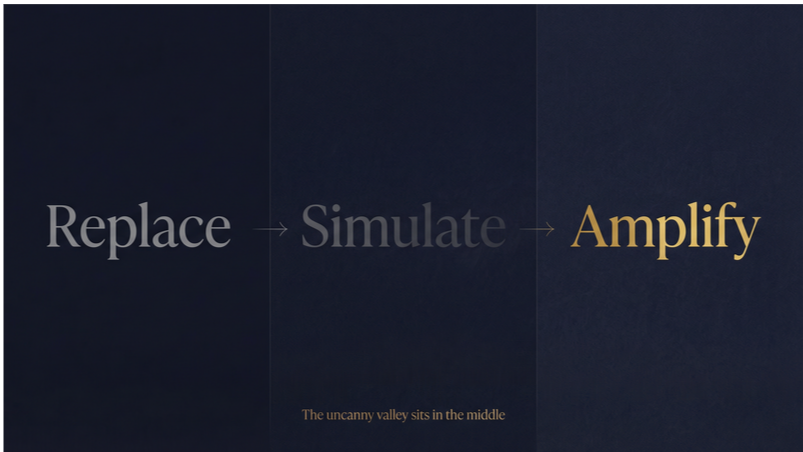
The Spectrum: Replace, Simulate, Amplify
The problem isn’t AI itself. It’s using AI to replace human connection rather than amplify it.
Picture a spectrum. On the far left, AI replaces human effort entirely: generated emails, synthetic video, chatbot interactions with no human oversight. On the far right, AI amplifies human capability, helping someone write faster, reach more people, maintain consistency without losing their voice.
The uncanny valley sits in the middle. This is where most brands are currently stuck. They’ve automated the appearance of personalization without the substance of it.
This distinction is what separates brands that use AI thoughtfully from those that stumble into the uncanny valley, a framework we explored in our analysis of the broader AI fatigue trend.
Why Two-Thirds of AI Initiatives Fail to Scale
McKinsey’s 2025 research on AI adoption reveals a telling pattern. Eighty-eight percent of companies now use AI in some capacity. But only one-third have successfully scaled it across their operations. The two-thirds that fail often fail not because the technology breaks, but because the output feels wrong. The emails sound slightly off. The recommendations feel invasive rather than helpful. The “personalized” content lands as generic.
This is the cost of landing in the uncanny valley. You’ve invested in technology that simulates human touch, but your customers detect the simulation and trust you less for attempting it.
The alternative requires a different starting assumption. Instead of asking “How can AI write our emails?” ask “How can AI help our people communicate more effectively?” The first question leads to the valley. The second leads to the far side of it.
Klaviyo’s 2026 marketing predictions put this bluntly:
“AI saturation will make authenticity a brand’s most valuable asset.”
As generated content becomes ubiquitous, the scarce resource becomes trust. And trust requires signals that can’t be synthesized: effort, attention, the specific irregularities of genuine human communication.
What the Right Side of the Spectrum Looks Like
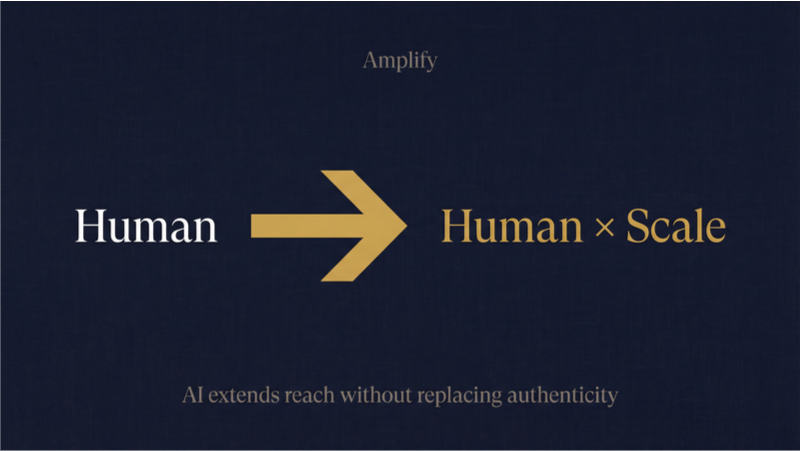
AI that amplifies rather than replaces starts with something authentically human and extends its reach. A founder’s actual voice, captured and preserved. A handwritten note, scaled to thousands without losing the individual variation that makes handwriting feel real. A personal story, adapted to different contexts but rooted in something that actually happened.
The technology is the same. The intention is different. One approach tries to trick the recipient into thinking a human wrote something a machine produced. The other uses machines to help humans do what they already do, connect with other humans, at a scale that would otherwise be impossible.
The data on handwritten mail effectiveness illustrates why this approach works: physical mail triggers stronger emotional responses in fMRI studies, requires 21% less cognitive effort to process, and produces 70% higher recall than digital ads. Companies like Stylograph take this approach with handwritten communication: capturing a person’s actual handwriting, then using AI to adapt the emotional tone and scale the output without losing the authenticity that makes handwriting meaningful.
The difference matters. The next time you get a message that feels slightly off, you’ll know which side of the valley it came from.
FAQ
What is the uncanny valley of AI communication?
The uncanny valley in AI communication occurs when AI-generated messages attempt to sound personal or human but fall slightly short, triggering discomfort and suspicion in the recipient. Just as almost-human robots feel creepier than clearly artificial ones, AI emails that try to simulate intimacy without earning it can feel more invasive than generic automated messages. The closer the simulation gets to human without achieving it, the stronger the negative reaction.
Why does AI personalization feel fake?
AI personalization feels fake when it mimics the surface patterns of human communication without the underlying substance. An email that uses your name and references your browsing history can feel more invasive than a generic message because the recipient senses an attempt at intimacy that hasn’t been earned. When the personalization pattern is detectable, when the reader can tell it’s generated, the simulation triggers suspicion rather than connection. Research from Sprout Social shows 55% of consumers are more likely to trust brands that publish human-generated content, rising to 66% for Gen Z and Millennials.
How can brands use AI without triggering consumer backlash?
Brands can avoid consumer backlash by using AI to amplify human communication rather than replace it. This means starting with something authentically human, like a founder’s voice, a handwritten note, or a personal story, and using AI to extend its reach while preserving its authenticity. The key distinction is intent: AI should help humans communicate more effectively, not attempt to simulate human connection that doesn’t exist. Brands that land on this side of the spectrum build trust rather than erode it.