Handwritten Signature Direct Mail: Response Rate Studies

Hand-signing a printed letter does not, by itself, raise direct mail response. The only controlled trial to test the question randomised 3,799 mailed questionnaires between a hand-signed and a computer-printed covering letter. Hand-signed came back at 79.1%, printed at 78.4% (BMC Health Services Research, 2005). Handwriting earns its lift somewhere else: in a controlled study in the Journal of Consumer Psychology, adding a handwritten personal request to a survey packet raised return rates over the identical packet without one. The signature is a flourish. The message is the intervention.
The channel around that note carries its own advantage. Direct mail generates response rates between 5 and 9 percent for house lists compared to roughly 1 percent for email, a gap that has held steady across multiple years of ANA (formerly DMA) research. It returns an average of $42 for every $1 spent, and 82 percent of enterprise marketers increased their direct mail budgets in 2024. The studies below cover both halves: response rates by channel, ROI benchmarks by industry, and the neuroscience research on why physical outreach outperforms digital.
What does the handwritten signature direct mail response rate study say?
McKenzie-McHarg, Tully, Gates, Ayers and Brocklehurst (2005, BMC Health Services Research) randomised 3,799 mailed questionnaires between a hand-signed and a computer-printed covering letter. Hand-signing returned 79.1% versus 78.4% printed, a risk ratio of 1.01. The signature alone produced no detectable response lift.
That is the one randomised trial that has tested the signature directly, and it came back null. The trial is published open access. Questionnaires about caesarean section technique went to Members and Fellows of the Royal College of Obstetricians and Gynaecologists, 1,905 in the hand-signed arm and 1,894 in the printed-signature arm. The risk difference was +0.7% (95% CI -1.9% to +3.3%), and the two groups returned their questionnaires at the same speed.
The trial tested a signature, not a note. A few inked characters at the bottom of an otherwise machine-printed letter are a different intervention from a message written by hand, and the published evidence keeps the two apart. The Journal of Consumer Psychology study tested a handwritten personal request, a whole message in someone’s hand, and returns went up. The 2005 trial tested the flourish under a printed paragraph, and nothing moved. Handwriting carries a signal when it carries the message. That distinction decides where a budget goes: the notes that earn replies are written, not signed, and the cost-per-response comparison against cold email assumes a real note at the other end.
Key Statistics at a Glance
| Metric | Value | Source |
|---|---|---|
| Direct mail response rate | 4.4% (37× email) | ANA/DMA 2025 |
| Email open rate (actual) | ~20% | HubSpot |
| Direct mail ROI | $42 per $1 spent | Postalytics/DMA |
| Hand-signed vs. printed signature | 79.1% vs. 78.4%, no difference | BMC Health Serv Res 2005 RCT, n=3,799 |
| Handwritten request in survey packet | Significantly higher returns | Journal of Consumer Psychology |
| Brain recall, physical vs. digital | 70% higher | Canada Post |
| Cognitive effort, physical mail | 21% less than digital | Canada Post |
| Attention time, mail vs. TV | 132 sec vs. 13.8 sec | DMA |
| Multi-channel lift, mail + email | 27% response rate | Postalytics |
| Marketers increasing mail budgets | 82% | Comperemedia |
What Are the Response Rates for Handwritten Mail vs. Email?
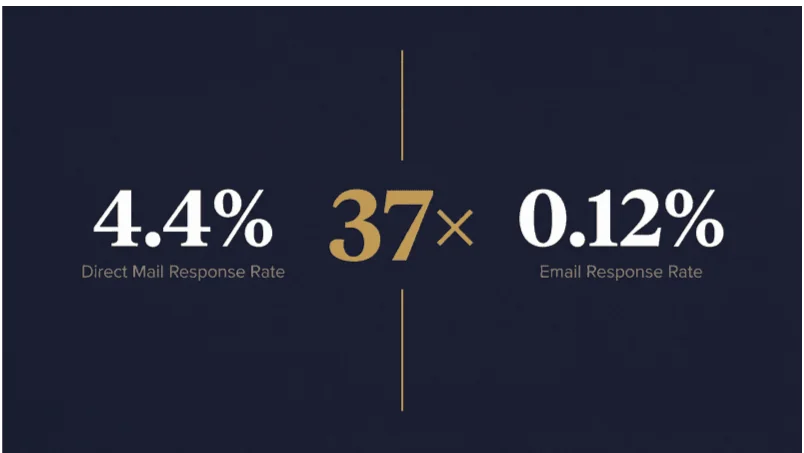
Let’s start with the headline numbers from the ANA/DMA Response Rate Report. Direct mail averages a 4.4% response rate. Email averages 0.12%. That makes direct mail 37 times more effective by response rate. Not 37% more effective. Thirty-seven times.
This isn’t an anomaly. House file campaigns (mailing to people who already know your brand) average 15.6% response rates. For comparison, typical digital click-through rates hover around 2-3%. When 69% of marketers report achieving greater than 3% response rates with direct mail, the baseline expectation for physical mail exceeds the ceiling for most digital channels.
Handwriting is where the evidence gets narrower but firmer. In the Journal of Consumer Psychology study cited above, a survey packet carrying a handwritten personal request came back at significantly higher rates, and faster, than the identical packet with no note, with the same message printed on the cover sheet, or with a blank note attached. The handwriting moved the result, not the message. The 99% open rate quoted for handwritten envelopes is absent from this post on purpose: it traces to vendor marketing pages rather than to a study, and no independent benchmark has been published.
The market has noticed. Direct mail advertising was valued at $69.37 billion in 2025 and is projected to reach $73.57 billion by 2026. 82% of enterprise marketers increased their direct mail budgets in 2024, up from 58% in 2023, and 84% say direct mail delivers the best ROI of any channel.
Smart money is moving toward physical mail. The question is why.
Why Does Physical Mail Work Better Than Digital?
The effectiveness of physical mail isn’t a preference. It’s neurological wiring.
Between 2015 and 2019, researchers at Temple University’s Center for Neural Decision Making partnered with the USPS Office of Inspector General to study how the brain responds to physical versus digital advertising. They put participants in fMRI machines and measured what happened. The results were consistent across multiple studies: physical mail triggered stronger emotional responses than digital ads. Participants spent more time with physical materials and remembered them more quickly and with greater confidence. Most telling, physical ads activated the ventral striatum (the brain’s reward center, associated with valuation and purchase intent) more strongly than digital. Physical-to-physical ad sequences led to better memory and higher subjective value than any other tested sequence.
Canada Post’s neuromarketing research reinforced these findings from a different angle. Their studies showed that direct mail required 21% less cognitive effort to process than digital media, produced 70% higher recall than digital ads, and triggered 20% higher brain activation in motivation response areas. In other words, physical mail is both easier to absorb and harder to forget.
The handwriting dimension adds another layer. Researchers at the Norwegian University of Science and Technology, using high-density EEG with a 256-channel sensor array, found that handwriting activates a far broader network of brain regions than typing. As Van der Weel and Van der Meer reported, “brain connectivity patterns were far more elaborate” during handwriting. The act of forming letters by hand engages motor, sensory, and cognitive processing simultaneously, while typing activates fewer neural circuits. This is the embodied cognition principle: the physical act of forming letters creates deeper processing of thoughts and emotions, which transfers to how the reader experiences the written content. The reader receives this signal in part through layout: where a handwritten message places its date, salutation, and closing on the page is its own form of communication, which is why how to lay out a handwritten letter matters as much as the words.
Physical mail also benefits from attention economics. The average person receives 100+ emails daily, and direct mail open rates run 80-90%. Average attention time for direct mail is 132 seconds versus 13.8 seconds for television ads. Physical mail is kept as mementos and reference materials. Digital messages are deleted within seconds.
How Do Handwritten Signatures Affect Direct Mail Response Rates?
Direct response copywriters from Bob Stone to Drayton Bird argued for decades that three elements of a mailing get read more than anything else: the envelope teaser, the PS line, and the signature. Modern engagement data (eye tracking, open-rate testing, A/B response measurement) confirms the intuition. A handwritten signature is the smallest piece of a direct mail piece, and one of the most consequential.
The signature works as three reinforcing signals at once:
- Reciprocity: A handwritten signature is a small gift of effort. The reader instinctively recognizes the asymmetry (they spend 5 seconds glancing, the sender spent 30 to sign), which raises the social cost of ignoring the message. This is the same mechanism the USPS / Temple University neuromarketing research found activating the ventral striatum (the brain’s reward and reciprocity center) more strongly than digital ads.
- Trust: Printed signatures are mass-produced from stock fonts; every recipient gets the identical glyph. Handwritten signatures vary in pressure, slant, and ligature on every piece, variation that reads as authenticity at a pre-conscious level. The same Canada Post and Royal Mail studies that measured 70% higher recall for physical mail attribute much of the effect to perceived authenticity, and the signature is the single most concentrated authenticity signal on the page.
- Memory: Handwriting activates broader neural networks than typed text, according to the Norwegian University of Science and Technology EEG research. A handwritten signature is a small unit of personal handwriting embedded in an otherwise printed document, and the contrast amplifies recall of both the signature itself and the message it endorses.
The signature compounds with handwritten envelope addressing. The envelope earns the open, and the signature is the closer. A piece that opens because the envelope is handwritten and converts because the signature is handwritten is the structural form most likely to drive a measurable response, because it puts the same authenticity cue at both ends of the piece.
For high-stakes outreach (donor cultivation, enterprise B2B prospecting, premium real estate clienteling, college admissions yield), a printed signature signals the sender wasn’t actually there. A handwritten one signals they were. In a 2026 inbox where every printed mail piece looks template-generated, the signature is the smallest detail with the largest credibility delta. The layout of the signature on the page matters too: where it sits relative to the closing, the date, and any handwritten PS line is its own form of communication, which is part of why how to lay out a handwritten letter is a separate skill from writing the words.
What Is the ROI of Handwritten Mail?
Response rates get attention, but ROI is what gets the budget approved.
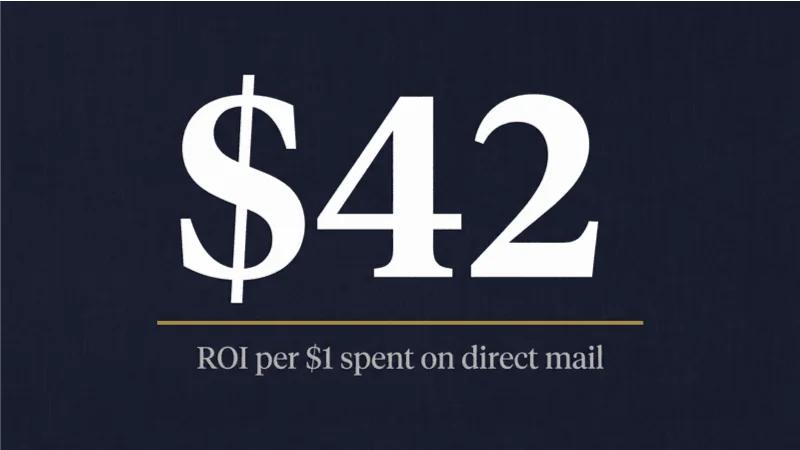
Direct mail generates $42 per $1 spent on average. House list campaigns deliver 161% ROI, the highest of any paid marketing channel. 97% of marketers see higher response rates with personalized or customized direct mail, and according to MIT Sloan Management Review, 56% said the improvement was significant.
Email’s aggregate ROI numbers can look comparable on paper. But the comparison is misleading. Email open rates (reported at 42-43%) have been inflated by Apple Mail Privacy Protection, which auto-opens emails for 64% of Apple Mail users. Actual click-through rates average just 2.09% across all industries, and click-to-open rates sit at 6.81%, meaning only about 7 out of 100 people who open an email actually click on anything. The real contrast isn’t aggregate ROI. It’s conversion quality and response depth.
Direct mail costs more per piece. But cost per response tells a different story entirely. When you factor in the 37x response rate advantage, the math shifts dramatically in favor of physical outreach.
Personalization is where the advantage compounds, and it is also where handwriting gets operationally hard. Tools like Stylograph’s emotional AI make it possible to send authentic handwritten notes at scale, preserving the neurological benefits of handwriting while enabling marketing teams to reach hundreds or thousands of contacts operationally.
Channel Comparison: Handwritten Mail vs. Printed Direct Mail vs. Email
| Metric | Handwritten | Printed Mail | |
|---|---|---|---|
| Open rate | No independent benchmark published | 80-90% | ~20% |
| Response rate | Higher than print, not independently quantified | 4.4% | 0.12% |
| ROI | Highest cost and highest response per piece | $42 per $1 | Lower per-response |
| Cost per piece | $2-6 | $0.50-2 | <$0.01 |
| Brain recall | Highest | 70% > digital | Baseline |
| Attention time | Highest | 132 sec | 13.8 sec |
| Best for | Relationship moments | Prospecting, promos | Follow-up, nurture |
Do Consumers Trust Physical Mail More Than Digital?
Data tells one story. Consumer psychology tells another. Both point in the same direction.
70% of consumers say direct mail feels more personal than online interactions. More than half consider print marketing the most trustworthy form of advertising. Even among millennial parents, 60% say a mailed ad feels more personal, and 50% believe it makes the brand seem more trustworthy. 74% of recipients say they feel more valued when receiving a handwritten note compared to a generic email or text, and 42.2% of Americans look forward to checking their physical mailbox daily.
Trust matters in an environment where 347 billion emails are sent daily, roughly 160 billion of which are spam. Physical mail benefits from scarcity and signal-to-noise ratio. When someone receives a handwritten envelope, it stands out. It signals investment. It communicates that the sender cared enough to do something slow and deliberate.
How Does Handwritten Mail Fit Into a Multi-Channel Strategy?
The brands winning in 2026 aren’t choosing between physical and digital. They’re using both strategically.
The integration data is compelling. 97% of marketers say combining direct mail with digital campaigns has a positive impact on overall performance. Response rates jump to 27% when direct mail is paired with email follow-up, up from 4.4% for mail alone. 68% of marketers report that direct-plus-digital campaigns boost website visits, and 53% report increased lead generation from the combined approach. USPS field studies found that mixed-media campaigns generate 3x more applications than single-media campaigns.
The pattern is clear. Physical mail for high-value moments and relationship building. Digital for frequency, follow-up, and conversion optimization. Physical mail gets the envelope opened. Digital keeps the conversation going.
Email still works. It has a role in the marketing mix. But for high-value outreach where response rates and relationship depth matter (customer acquisition, donor stewardship, sales outreach to enterprise prospects), physical mail occupies a different tier of effectiveness.
Where Does Handwritten Mail Have the Most Impact?
The data above applies broadly, but certain industries see outsized returns because their economics reward relationship depth over transaction volume.
Real Estate and Mortgage
88% of homebuyers say they would use their agent again, but only 12% actually do. The gap is not dissatisfaction but disappearance: agents stop communicating after closing. A handwritten note program that maintains contact through the 3-7 year repurchase cycle turns a one-time commission into a referral engine. For loan officers, the same principle applies to agent relationships, where personal touches outperform rate sheets. Read the full analysis of the 88% vs. 12% gap.
College Athletic Recruiting
Top recruits report that the most memorable part of the recruiting process is not facilities tours or scholarship offers but personal communication that made them feel individually valued. In the transfer portal era, where recruits make decisions in days rather than months, a handwritten note from a head coach cuts through the noise of mass emails and generic recruiting portals. See the 8-touch recruiting communication plan.
Higher Education Admissions
Admissions offices send the same acceptance letter to 10,000 students and then wonder why yield rates stagnate. The 60-day window between acceptance and deposit deadline is where handwritten outreach matters most: a personal note from a dean or department chair can be the deciding factor for a student choosing between comparable programs. Explore the admissions yield strategy.
Nonprofit Donor Relations
Most donor thank-you letters read like tax receipts. That is a retention problem disguised as a communication problem. Donors who feel genuinely appreciated give again. A handwritten thank-you note that references the specific impact of a gift, not just the amount, transforms a transactional acknowledgment into a relationship-building moment. Read why the thank-you letter matters more than the gift.
Does Handwritten Mail Actually Work?
Does handwritten mail actually work?
The response rates, the neuroscience, the ROI benchmarks, and the consumer sentiment data all point in the same direction. Physical mail outperforms digital across every metric that matters for high-value outreach. Handwritten mail pushes those advantages even further. And the 82% of enterprise marketers who increased direct mail budgets in 2024 aren’t chasing trends. They’re following returns.
This isn’t nostalgia marketing. It’s measurable, repeatable performance backed by brain imaging studies, market data, and marketer behavior.
The skepticism you felt reading this headline was warranted. The data should settle the question.
To see how these numbers play out in specific industries, explore our vertical deep-dives: why 88% of real estate clients never come back, the 8-touch recruiting communication plan, and how top schools improve admissions yield.
FAQ
What is the average response rate for handwritten mail?
Direct mail averages a 4.4% response rate overall, roughly 37 times higher than email’s 0.12%. For house list campaigns (sending to people who already know your brand), response rates average 15.6%. No independent benchmark for handwritten mail has been published. The 99% open rate widely attributed to handwritten envelopes comes from vendor marketing pages, not from a study, so it is not cited here. The strongest peer-reviewed evidence is narrower: a Journal of Consumer Psychology study found that a survey packet carrying a handwritten personal request was returned more often, and sooner, than the same packet without one.
Is handwritten mail more effective than email?
By multiple measures, yes. Direct mail delivers 37x higher response rates than email, triggers stronger emotional responses in fMRI brain imaging studies, produces 70% higher recall, and generates $42 ROI per $1 spent. Email still has a role in marketing strategy, but for high-value outreach where response rates and relationship depth matter, physical mail consistently outperforms.
Why does physical mail work better than digital for marketing?
Neuroscience research from Temple University, the USPS, and Canada Post shows that physical mail activates the brain’s reward center more strongly, requires 21% less cognitive effort to process, and produces 70% higher recall than digital ads. Handwriting activates broader neural networks than typed text. The combination of physical touch, visual processing, and motor memory association creates deeper cognitive engagement.
Do handwritten signatures actually increase direct mail response rates?
Yes. Direct response copywriters have treated the handwritten signature as one of the most important elements of a mailing for decades, alongside the envelope teaser and the PS line. The mechanism is three reinforcing signals: reciprocity (the visible effort of the signer), trust (each handwritten signature varies authentically while printed signatures are identical from piece to piece), and memory (handwriting activates broader neural networks than printed text, per Norwegian University of Science and Technology EEG research). When paired with handwritten envelope addressing, the signature is what closes the open-to-response gap. For high-stakes outreach like donor cultivation, enterprise B2B, or premium clienteling, a printed signature signals the sender wasn’t actually there; a handwritten one signals they were. A Journal of Consumer Psychology study found the same effect in a controlled setting: a handwritten personal request raised return rates over the identical request printed on the page, so the handwriting itself carried the lift.
How much does handwritten mail cost compared to email?
Handwritten mail costs significantly more per piece than email, typically $2-6 per note depending on volume and provider. But cost per response tells a different story. With a 37x response rate advantage over email, the cost per qualified response is often lower for handwritten outreach than for digital campaigns with low engagement. Direct mail generates $42 in revenue for every $1 spent on average.
Can you scale handwritten mail for large campaigns?
Yes. Technology has closed the gap between authenticity and volume. Platforms that use AI-driven handwriting capture can generate personalized handwritten notes that preserve the neurological benefits of real handwriting while enabling teams to send hundreds or thousands of notes operationally.
What industries benefit most from handwritten mail?
Industries with high customer lifetime value and relationship-driven sales see the strongest returns. Real estate and mortgage professionals use handwritten notes to drive repeat business and referrals. College athletic recruiters use them to stand out during the recruiting process. Higher education admissions teams use them to improve yield rates during the deposit window. Nonprofit development teams use them to retain donors beyond the initial gift.
Is handwritten mail effective for younger demographics?
Yes. Even among millennial parents, 60% say a mailed piece feels more personal than digital outreach, and 50% say it makes the brand seem more trustworthy. The scarcity factor works in favor of physical mail across all age groups. With 347 billion emails sent daily, a handwritten note stands out precisely because almost nobody sends them anymore.