Admissions Yield Strategy: Winning the 60-Day Deposit Window

If you sent 10,000 acceptance letters and your yield rate is 30%, you are about to lose 7,000 students. At $20,000 in net tuition per student, that is $140 million walking out the door.
The clock is running. The 60-day window between acceptance notifications and the May 1 deposit deadline is the most expensive sprint in your enrollment calendar. The schools converting at higher rates treat yield season as a sales operation, not an administrative process. They break the pattern. Here is what the data shows actually works.
The Admissions Yield Crisis: A Conversion Problem in Academic Clothing
The national average yield rate for four-year institutions sits at approximately 30%. Private colleges average around 33%; public institutions hover closer to 25%. Elite institutions with strong brand recognition can push past 70%, but they are the exception.
Since 2016, overall yield rates have fallen from 36% to 30%. Public institutions have experienced the steepest decline, an 11% drop. The trend is not seasonal fluctuation. It is structural pressure.
The enrollment cliff is no longer theoretical. High school graduates peaked at roughly 3.9 million in 2025 and will decline approximately 13% by 2041, a 15-year slide driven by post-2008 recession birth rate declines. More than 120 U.S. colleges have closed or merged since 2016. The institutions surviving this compression will be the ones that treat every admitted student as a conversion opportunity worth fighting for.
Enrollment leaders already know this intellectually. Reframing it as a conversion rate problem, the language of sales rather than academia, moves it from the strategic plan to the operations floor. If your yield rate is 30% and you move it to 32%, those two percentage points on a class of 2,000 students equals 40 additional deposits. At $20,000 net tuition revenue per student, that is $800,000 in revenue against virtually zero marginal cost.
Why the Standard Playbook Plateaus
Most admissions offices run the same sequence during yield season: email drip campaigns, viewbooks, admitted student events, financial aid packages. These are table stakes, not differentiators. When every competing institution executes the same playbook, none of it breaks through.
The data confirms this. According to the Ellucian Student Voice Report 2025, 61% of students prefer personalized content. Yet only 32% are willing to share their home address with institutions, making physical mail that arrives unexpectedly a genuine pattern interrupt. Students are inundated with digital communication; the inbox is a battlefield where every subject line competes for milliseconds of attention.
The cost anxiety is real: 56% of students who chose not to enroll cited cost and financial concerns as the primary reason. Generic congratulations messaging that ignores this anxiety underperforms against communication that directly addresses the financial decision-making process.
The problem is not effort. The problem is sameness. When every school sends the same sequence of emails, hires the same event photographers, and produces the same glossy viewbooks, students cannot distinguish one institutional brand from another.

What High-Converters Do Differently
EAB data shows that earlier, more personalized recruitment outreach more than doubles the likelihood of admitted students depositing. The schools achieving this are not running a different playbook. They are breaking the format entirely.
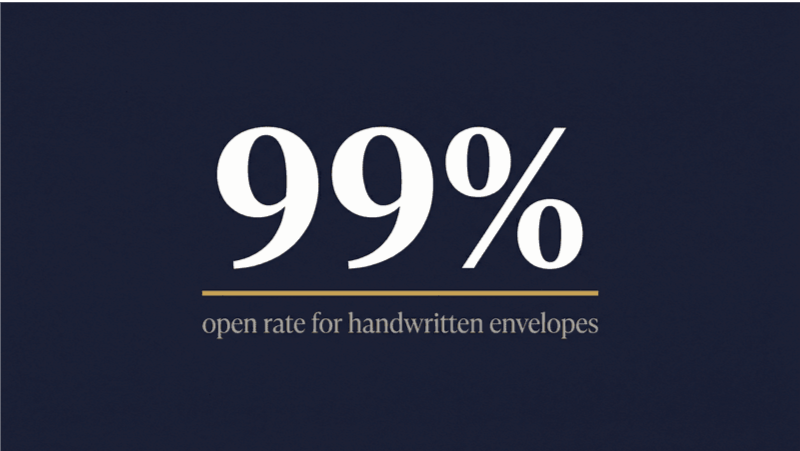
The pattern starts with physical outreach. Handwritten notes from department chairs, coaches, or faculty in the student’s intended major arrive unexpected and unreadable as mass mail. Industry data shows handwritten envelopes achieve 99% open rates versus approximately 20% for email marketing. The physical piece signals investment; the handwriting signals individual attention. Concept3D identifies handwritten notes following campus visits as a recommended personalized follow-up channel for Generation Z admissions strategies. With 93.4% of U.S. consumers preferring human interaction over AI for customer service, this preference extends naturally to the admissions experience.
The same principle applies to conversations. One-on-one calls from current students in similar academic programs or geographic regions outperform scripted calls from admissions staff because peer credibility carries weight that institutional messaging cannot replicate. Small cohort events for specific academic programs, geographic clusters, or interest groups create intimacy that large admitted student days miss entirely.
Financial transparency rounds out the approach. Addressing cost concerns before the student asks, connecting families to financial aid counselors, and discussing value propositions openly signals confidence rather than defensiveness. When 56% of non-enrolling students cite cost as the deciding factor, the institutions that lean into that conversation rather than avoiding it gain an edge.
The physical side of this equation is where the real whitespace exists. Most schools have invested in digital personalization. Very few have scaled personal, tangible outreach during the deposit window. Students want to feel individually chosen, not batch-processed. (For admissions teams looking to operationalize this kind of personalized outreach, see how Stylograph supports admissions yield with handwritten notes at scale.)
The ROI Frame
Let us run the numbers on a specific intervention: personalized handwritten notes.
Assume a program costs $4 per student including production and postage. For 2,000 admitted students, that is $8,000.
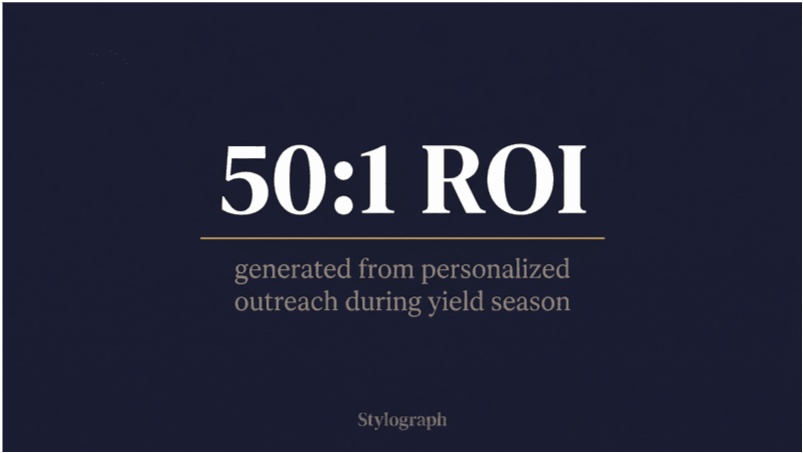
If this outreach moves yield by even one percentage point on a target class of 2,000, that is 20 additional students. At $20,000 net tuition revenue per student, a conservative estimate for most four-year institutions, that is $400,000 in revenue against $8,000 in spend.
That is a 50:1 return. And that assumes only a single percentage point improvement.
Even if the math is half-right, the logic holds. In a yield environment where every deposit matters more than it did five years ago, physical, personal outreach during the 60-day sprint is among the highest-leverage investments an enrollment office can make. For a comprehensive look at the response rate and ROI data behind this, see our analysis of handwritten mail effectiveness.
The Time Is Now
The March-to-May deposit window is open right now. The institutions that convert at the highest rates share one operational characteristic: they treat yield season as a coordinated sprint with clear ownership, specific interventions, and measured outcomes.
The playbook is not secret. The data is available. The only variable is execution.
For deeper context on how personalized communication drives enrollment outcomes, explore how physical outreach addresses why students see accepted letters as identical, and the critical role of donor recognition and relationship-building in supporting enrollment initiatives.
See how institutions are scaling personal outreach to 5,000 admitted students during yield season. Book a 15-Minute Demo
FAQ
What is a good yield rate for a university?
The national average yield rate for four-year institutions is approximately 30%. Private institutions average around 33%, while public institutions average closer to 25%. Elite institutions with strong brand recognition can achieve yield rates above 70%. Even small improvements in yield can translate to significant tuition revenue gains.
How can admissions offices improve yield during the deposit window?
The highest-impact strategies break the pattern of batch communication. Personalized physical outreach like handwritten notes, one-on-one calls from faculty or student ambassadors, and micro-events for targeted cohorts outperform mass email campaigns. EAB research shows that personalized early outreach can more than double deposit likelihood.
What is the ROI of personalized outreach during admissions yield season?
A handwritten note program at $4 per student sent to 2,000 admitted students costs $8,000. If it moves yield by a single percentage point, that is 20 additional enrolled students. At $20,000 net tuition revenue per student, the return is $400,000 against $8,000 in spend, a 50:1 ratio. Even at half that impact, the investment pays for itself many times over.