
In December 2025, McDonald’s Netherlands thought they had a clever holiday campaign. Their AI-generated ad showed a family gathered around a table, a warm Christmas atmosphere, all of it rendered by machine. They called it “It’s the Most Terrible Time of the Year.” The public called it something else: soulless, creepy, falling into the uncanny valley. McDonald’s pulled the ad within days.
This wasn’t an isolated mistake. Coca-Cola’s AI holiday campaign drew backlash for the second consecutive year. The pattern is becoming unmistakable: consumers are tired of AI-generated sameness, and they are punishing brands that overstep.

A shot from McDonald’s AI slop advertisement
The data tells the same story. A 2025 study by Kinsta and Propeller Insights found 93.4% of U.S. consumers prefer interacting with a human over AI for customer service. Nearly 89% believe companies should always offer a human option. Sprout Social’s Q3 2025 Pulse Survey found 55% of people are more likely to trust brands that publish human-generated content; among Gen Z and Millennials, that number jumps to 66%. The top concern consumers had about brand behavior on social media? Posting AI-generated content without disclosing it.
The message is clear and loud: AI has crossed from novelty to nuisance, and the backlash is real.
The Saturation Problem
AI is everywhere because it works, at scale. McKinsey’s 2025 report found 88% of companies now use AI across their businesses. Over 80% of brands deploy it for email, social, and content creation. The result is a flood of machine-generated sameness that consumers can spot instantly. Merriam-Webster named “slop” its 2025 word of the year, defining it as digital content of low quality produced in quantity by artificial intelligence.
The digital channel itself is reaching saturation. The Institute of Digital Marketing New Zealand reported in December 2025 that 60% of searches now end without a click , thanks to AI overviews that summarize answers before users ever reach a website. The feed is infinite. The inbox is full. The attention is gone.
Yet only one-third of companies have successfully scaled their AI initiatives, according to McKinsey. Most are generating noise without signal, content without connection. They have automated the work but killed the impact.
This creates a paradox. Companies are producing more marketing material than ever before, but each piece matters less. The marginal utility of additional AI-generated content approaches zero while the reputational risk of being caught in the AI fatigue backlash grows daily.
What Consumers Actually Want
Sprout Social’s Q4 2025 Pulse Survey asked consumers what they want brands to prioritize in 2026. The number one answer: crafting human-generated content. Not faster response times. Not lower prices. Human content.
This is not nostalgia. It is basic human psychology: we value things that cost the sender something. A text costs nothing. An email costs almost nothing. A physical letter requires materials, postage, time. That cost conveys commitment. In a world of frictionless digital communication, friction itself becomes a feature.
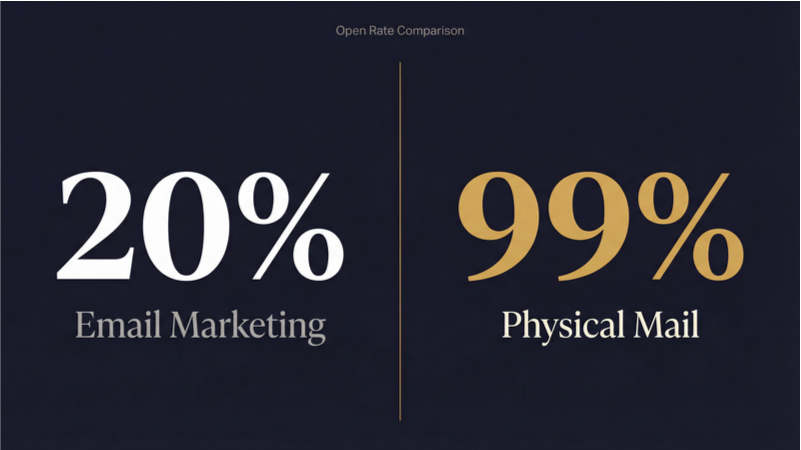
A handwritten envelope has a 99% open rate. Email marketing averages around 20%. The gap is not about format. It is about perceived effort. When someone receives a physical piece of mail, they know someone spent time, money, and attention to reach them. That signal cuts through the noise. (For the full research behind these numbers, including neuroscience, response rate benchmarks, and ROI data, see our comprehensive analysis of handwritten mail effectiveness. For sales teams in particular, the 37x response-rate gap between B2B direct mail and email is the cleanest illustration of this dynamic.)
Mike Donoghue, CEO of Subtext, put it plainly in MarTech:
“In 2026, the brands that forgo human connection will lose. AI is turning communication into a commodity. People want to talk through machines, not to machines.”
The Real Distinction
The conversation about AI in marketing has been stuck in a false binary: AI versus human. The actual distinction is different. There is AI that replaces human touch, and there is AI that amplifies it. The former is what McDonald’s tried. The latter is where the opportunity lives.
AI that replaces tries to fake humanity. It generates faces that never existed, writes copy that sounds almost right, produces images that hover in the uncanny valley. It asks: how close can we get to real without being real?
AI that amplifies starts with something authentically human and makes it scalable. It captures a person’s actual handwriting, learns the natural variation in their letterforms, then applies that genuine human signal to messages that would otherwise be impossible to send by hand. The AI serves the connection rather than substituting for it.
This distinction matters because consumers are not anti-technology. They are anti-fake. They resent being treated as targets for synthetic content. They respond to signals of genuine effort, even when those signals are produced with technological assistance.
The ethical line is clear: using AI to extend a real human’s reach respects the relationship. Using AI to simulate human presence risks undermining it. Consumers can tell the difference.
What This Means for 2026
The marketing playbook of 2025 was about automation: generate more, publish faster, optimize endlessly. The playbook for 2026 is about signal-to-noise ratio. The brands that win will be the ones that use AI to amplify what feels human, not automate what replaces it.
Physical mail is having a moment not because it is old-fashioned, but because it is scarce. In a world of infinite digital content, physical communication is finite, costly, and meaningful for that very reason. It carries weight that pixels cannot. If you have not written a letter in years, our guide to handwritten letters makes the process simple.
The strategic implication is significant. Companies should audit their AI use across two dimensions: does this application replace human connection or extend it? Does it create genuine value for the recipient or merely optimize for the sender? Applications that fail either test should be reconsidered.
For a deeper exploration of where the line between AI simulation and human amplification sits, see our analysis of the uncanny valley of AI communication.
At Stylograph, we sit on the amplify side of this divide. Our technology captures each person’s actual handwriting and adapts it based on the emotional context of their message. We use AI to make physical communication feel more personal, not less. The handwriting is real. The variation is real. The signal is real.
The companies that thrive in 2026 will understand this distinction. They will use AI to extend human capability rather than simulate human presence. They will recognize that trust is built on effort, not efficiency. And they will remember that in a world of infinite content, the scarcest resource is genuine connection.
FAQ
What is AI fatigue in marketing?
AI fatigue is the growing consumer backlash against AI-generated marketing content. As 88% of companies now use AI for content creation, audiences are overwhelmed by machine-generated sameness. Studies show 93% of consumers prefer human interaction, and 55% are more likely to trust brands that publish human-generated content. The result is that AI-produced emails, ads, and social posts are increasingly ignored or actively punished by consumers.
Why is physical mail outperforming digital marketing?
Physical mail outperforms digital because scarcity creates value. Handwritten envelopes achieve 99% open rates versus roughly 20% for email. In a world of infinite digital content, a physical letter signals genuine effort and cost, which consumers interpret as care. Direct mail delivers 37x higher response rates than email because the medium itself communicates commitment in a way that frictionless digital channels cannot.
How can brands use AI in marketing without alienating consumers?
The key distinction is between AI that replaces human connection and AI that amplifies it. AI that generates fake faces, synthetic copy, or simulated warmth triggers backlash. AI that extends a real person’s reach, such as capturing actual handwriting and scaling it with natural variation, respects the relationship. Brands should audit every AI application against two questions: does it create genuine value for the recipient, and does it preserve authentic human signal?